Why Local Stores Are Losing Customers to Quick Commerce (And How to Stop It)
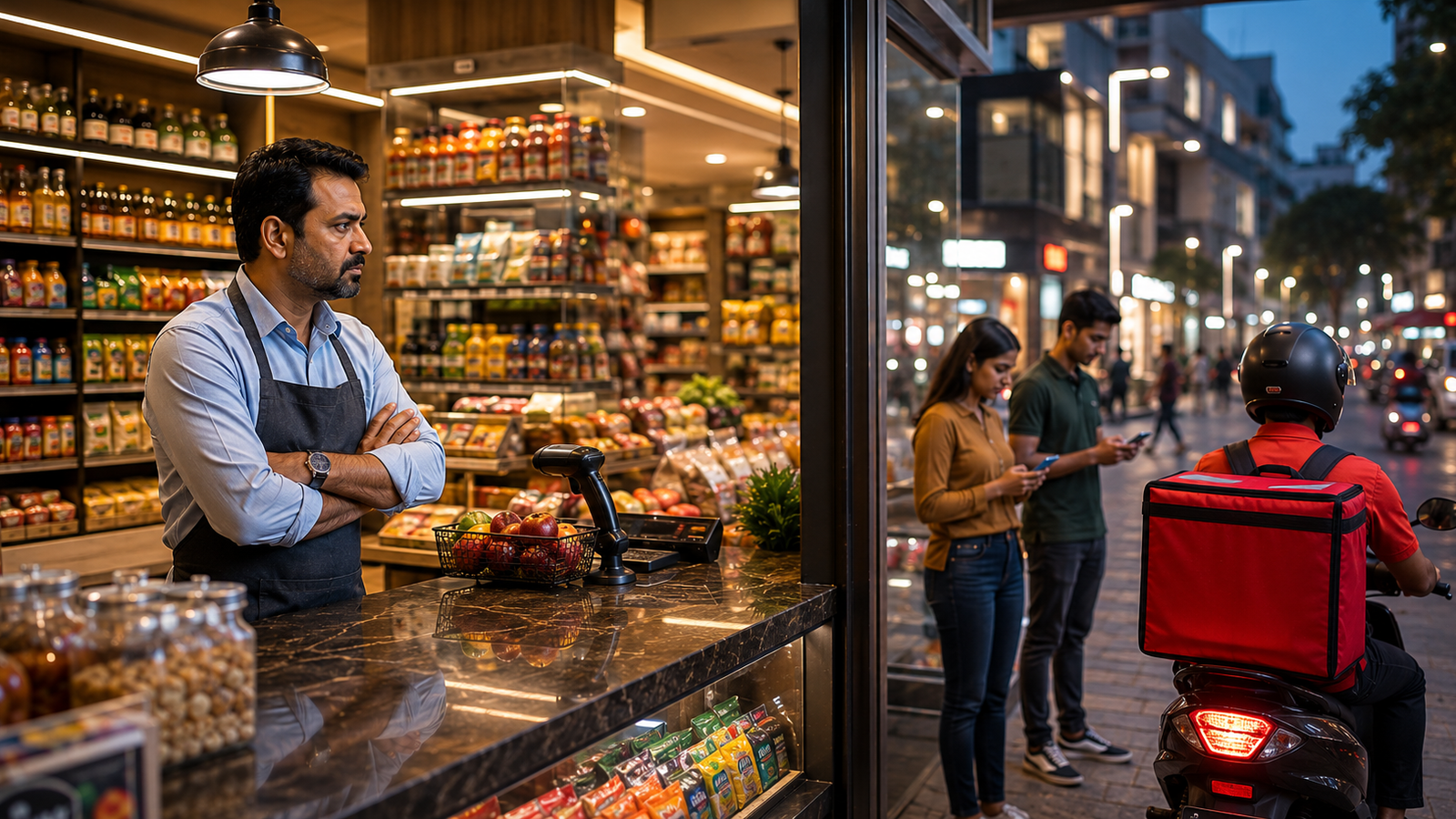
Quick commerce is growing fast—but it’s quietly taking your customers. Here’s how local stores can fight back and win.
Published 1st Apr 2026 · 2 min read · By Team Areakart
If you run a grocery shop, you already know quick commerce is at your door. But here's what most retail owners haven't fully registered yet: it's no longer just about groceries.
Quick commerce platforms have built 40,000+ SKU catalogues and are aggressively expanding beyond food into electronics, personal care, beauty, gifting, stationery, pharma, and even fashion. The ten-minute promise that pulled customers away from kirana shops is now being pointed at your category — whether you sell phone accessories, cosmetics, medicines, home goods, or gifts.
This piece is for the non-grocery local retailer: the pharmacy, the mobile shop, the cosmetics store, the gift shop, the stationery store, the boutique. Here's why your customers are starting to drift — and the specific, practical way to stop it.
The quiet expansion nobody warned you about
Quick commerce didn't stay in its lane. Electronics and accessories is projected to be one of the fastest-growing categories on these platforms through 2031. Players have moved aggressively into beauty and personal care, household goods, and impulse/gifting items — exactly the categories that local retail stores have owned for decades.
Why does this matter to you specifically? Because the customer behaviour quick commerce trained for groceries — "I want it now, I'll just tap the app" — doesn't stay confined to atta and milk. Once a customer is comfortable ordering anything in ten minutes, they start defaulting to the app for the phone charger, the lipstick, the birthday gift, the paracetamol. Your category is next in line, and for some of you it's already happening.
Who's most exposed (find yourself on this list)
Not every retail store faces the same pressure. Here's the honest ranking:
High exposure — act now:
- Pharmacies / medical stores — quick commerce and online pharmacy are converging fast; the "I need it now" use case is identical.
- Electronics & mobile accessories — fast-growing on q-commerce, easy to ship, impulse-friendly.
- Cosmetics & personal care — beauty is a stated expansion priority for these platforms.
- Gifting & stationery — impulse and last-minute purchases that q-commerce is built to capture.
Moderate exposure — build your moat:
- Fashion & boutiques — q-commerce is experimenting here (quick fashion), but fit, feel, and trust still favour you.
- Home goods & hardware — bulkier, more considered purchases; you have time, but don't waste it.
If you're in the first group, the customers you're losing aren't theoretical. They're the ones who used to walk in for the small, urgent, impulse buys — the highest-frequency, easiest trips — and now tap an app instead.
Why they actually switch (it's not price)
Your prices are often competitive. Your product knowledge is better. Your service is more personal. So why do customers drift to an app? The same three frictions that hit grocery stores hit you:
- You're not on their phone when the urge hits. The customer realises they need a phone case, a gift, a moisturiser at 10 PM. You're closed or invisible. The app isn't.
- No way to reorder or be reminded. The pharmacy customer who needs a monthly refill, the parent who buys the same school supplies every term — an app remembers and nudges. You rely on them remembering you.
- No delivery, or informal delivery. "Send me on WhatsApp, I'll deliver" works until it doesn't — no order trail, no tracking, no system during a rush.
Every one of these is a "you're not online in a usable way" problem — not a "your shop is worse" problem. Which is excellent news, because it's fixable without dropping your prices or competing on ten-minute logistics.
What you have that quick commerce never will
Before the fix, get clear on your advantages — because your strategy should lean into them, not abandon them:
- Trust and advice. A pharmacist who knows the customer, a mobile-shop owner who actually explains the phone, a boutique owner with taste — q-commerce has none of this. It's a vending machine. You're a relationship.
- Curation. You stock what your specific neighbourhood wants. An algorithm stocks what sells nationally.
- Personal service and returns. Try-before-you-buy, easy exchanges, a familiar face — friction-free in ways an app can't match.
- Local presence. You're here. For many purchases, "I'll pick it up / it'll come from the shop down the road" beats a dark store warehouse.
The goal isn't to become a worse version of Zepto. It's to put your existing advantages onto a phone screen so customers can use them as conveniently as they use an app.
How to stop the bleed: your own branded ordering channel
The fix is the same shape as it is for grocery, adapted to retail: give your own customers a branded online store and ordering app that's yours — so the trust and service they value is available on their phone, anytime, with delivery, commission-free.
Here's what that does for a retail store specifically:
Your storefront, your brand. Customers browse your curated catalogue under your shop's name — not a national marketplace where your curation and advice disappear into a search algorithm.
Reorder and reminder tools. The pharmacy refill, the recurring stationery order, the regular cosmetics purchase — turn these into one-tap reorders and WhatsApp reminders. This is the exact mechanism q-commerce uses against you; now it's yours.
Commission-free. A flat subscription instead of surrendering 20–30% of each order to a marketplace. Your margin stays yours.
Customer data you own. Every order is a phone number and a purchase history you control — to drive repeat business, festival offers, and loyalty. On a marketplace, that customer is theirs.
Delivery, made systematic. Replace "WhatsApp pe bhej do" with real orders, real tracking, real delivery timings — so it feels as reliable as an app.
A practical 30-day plan for retail
Week 1 — Launch with your best-sellers and your highest-repeat items. For a pharmacy, that's your common refills. For electronics, your top accessories. For cosmetics, your fastest movers. Don't load your whole catalogue — start with what drives frequency.
Week 2 — Convert your existing footfall. Counter QR code, WhatsApp broadcast to your customer list, a line every staff member says: "Aap online bhi order kar sakte ho, hum bhej denge." Your walk-in customers are your launch audience.
Week 3 — Win the first online order. A small first-order incentive breaks the "I'll just use the app" reflex once. After one smooth order from you, habit re-forms around your shop.
Week 4 — Build the repeat loop. WhatsApp reminders for refills and recurring buys. This is where retail wins big — your highest-frequency customers (pharmacy, regular purchases) become locked-in repeat orders instead of drifting to apps.
The bottom line
Quick commerce escaped the grocery aisle and is now coming for pharmacy, electronics, beauty, gifting, and beyond. The customers you're starting to lose aren't leaving because your shop is worse — they're leaving because the app is available on their phone and you're not.
Your trust, curation, and service are advantages no dark store can replicate. Put them on a branded, commission-free ordering channel, and you don't just stop the bleed — you give your customers a better reason to choose you than convenience alone. Because now you're convenient and better.
Don't wait for quick commerce to reach your category. Set up your commission-free Areakart store → — your retail shop, online, in under 24 hours. No tech skills needed.